P.S. 160
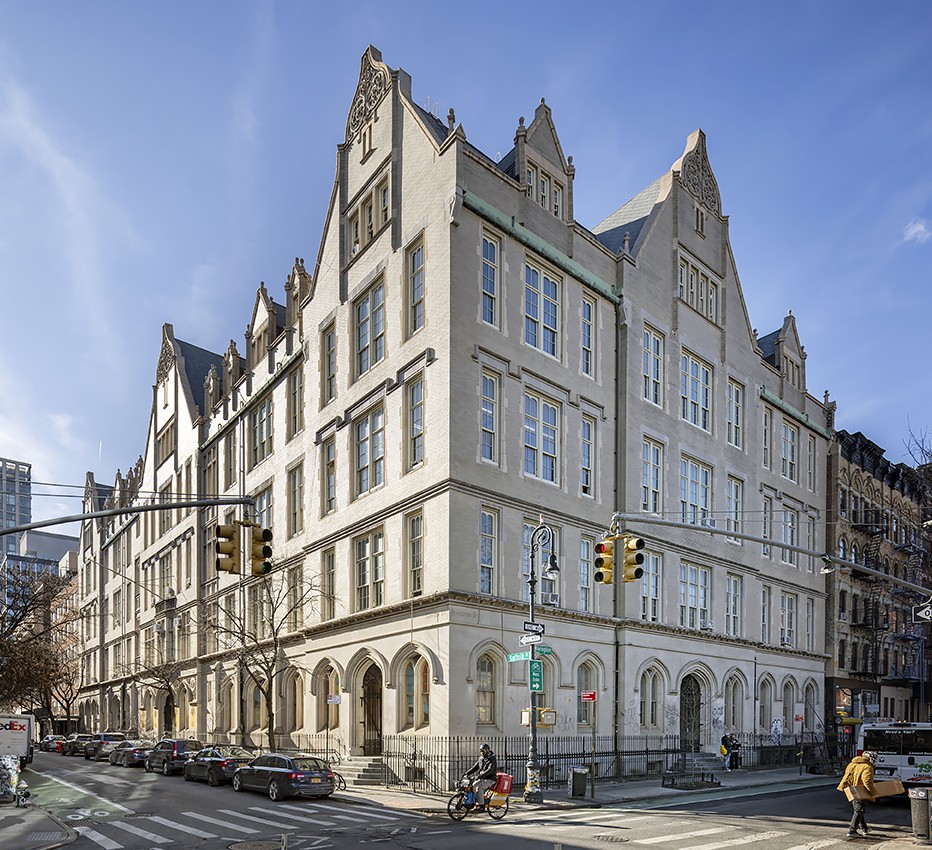
The imposing, Collegiate Gothic-style former P.S. 160 at 107 Suffolk Street, dated 1897-99, presents itself almost as a Gilded Age mansion, set on a narrow street among aging, relatively diminutive tenements. This striking effect is the result of several factors converging at the end of the 19th century, a period when there was an enormous influx of immigrants settling in New York, and nowhere more so than in this Lower East Side neighborhood.
An unprecedented increase in population meant countless children who, with, compulsory laws, were required to attend school. This was a moment of crisis and promise. A widespread campaign brought new school construction to Manhattan and the Bronx, and then to the five boroughs, after Consolidation. The gifted architect in charge, C.B.J. Snyder, more than met the challenge and became renowned nationally for the Progressive Era innovations he provided within each school, and for their stunning outward appearances.
Each new Snyder building communicated the message that education was of the utmost importance. Not surprisingly, the traditional Lower East Side—from 14th Street to the Brooklyn Bridge and west to Broadway—had the largest concentration of Snyder schools in the city, numbering 39.
The Lower East Side below Houston Street, with no Historic District designations, needs protection for its most significant buildings and streetscapes, as rampant development threatens to erase the neighborhood’s storied past. The historic surroundings of former P.S. 160 remain mostly intact.
For many years The Clemente Soto Vélez Cultural & Educational Center has occupied the building, which functions as an arts facility. The Clemente celebrates Puerto Rican and Latinx culture with a multi-ethnic and international vision. Considering the building’s impressive architecture, history, and mission, The Clemente clearly deserves recognition as a NYC Individual Landmark.